Yale Announces 2025 Frederick Douglass Book Prize Finalists
Yale University’s Gilder Lehrman Center for the Study of Slavery, Resistance, and Abolition has announced the finalists for the twenty-seventh annual Frederick Douglass Book Prize, one of the most prestigious awards for global studies of slavery, opposition to it, and the experiences and resistance of enslaved people. Jointly sponsored by the Gilder Lehrman Institute of American History in New York City and the Gilder Lehrman Center for the Study of Slavery, Resistance, and Abolition at Yale University’s MacMillan Center, this annual prize of $25,000 recognizes the best book written in English on the topics of slavery, resistance, or abolition copyrighted in the preceding year.
The four finalists for the 2025 prize are: Justene Hill Edwards for “Savings and Trust: The Rise and Betrayal of the Freedman’s Bank” (W. W. Norton and Company); Keidrick Roy for “American Dark Age: Racial Feudalism and the Rise of Black Liberalism” (Princeton University Press); Makhroufi Ousmane Traoré for “Slavery, Resistance, and Identity in Early Modern West Africa: The Ethnic-State of Gajaaga” (Cambridge University Press); and Gloria McCahon Whiting for “Belonging: An Intimate History of Slavery and Family in Early New England” (University of Pennsylvania Press).
The winner will be announced following the Frederick Douglass Book Prize Review Committee meeting in the fall, and the award will be presented at a celebration at Trinity Church Wall Street in New York City on February 12, 2026.
From a total of 80 submissions, the finalists were selected by a jury of scholars that included Juanita De Barros (chair), Professor of History and Director, McMaster University Centre for Human Rights and Restorative Justice; Jamelle Bouie, New York Times columnist; and Toby Green, Professor of Precolonial and Lusophone African History and Culture, King’s College, London. Noting the challenge of selecting a small list of finalists from the large number of “haunting and powerfully written books” submitted, the three jurors thanked all of the authors and their publishers for their “belief in the importance of this subject and the dedication with which their collective work ensures the vitality of this crucial field of history in these painful times.”
The jury’s descriptions of the four finalists follow.
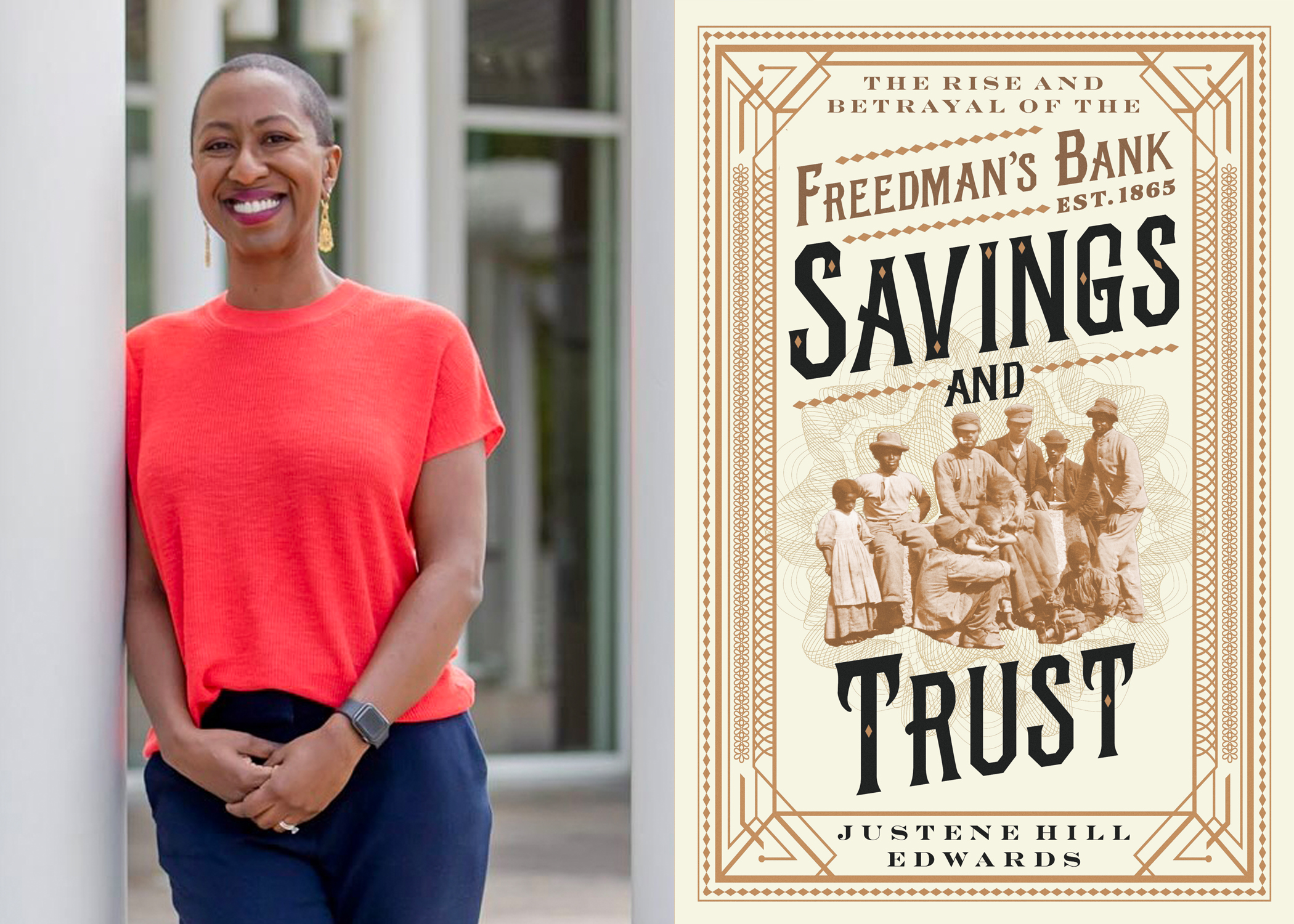
Justene Hill Edwards’ “Savings and Trust” is an impressive work of historical recovery. Hill Edwards tells the little-known but important story of the Freedman's Bank in the post-Civil War United States. After the war’s end, tens of thousands of African Americans deposited the equivalent of US$1.5 billion in the bank by 1873, encouraged by the hope that putting their hard-earned money in this financial institution would help them achieve economic independence. The book moves between the stories of the individual African American women and men who used the bank, well-known figures such as Frederick Douglass, and the white trustees whose actions led to its collapse. This is a crucial work that brings to light a little-known aspect of the turbocharging of the racial wealth gap in nineteenth-century U.S. history.

In his extraordinary book, “American Dark Age: Racial Feudalism and the Rise of Black Liberalism,” Keidrick Roy demonstrates that the language and imagery of an imagined feudal past has deep roots in the political life in the United States. Beginning in the revolutionary era, early Americans repudiated the aristocratic pretensions of the British while embracing an “aristocracy of the skin” based on a “ruling class of White citizens vis-a-vis an underclass of Black servants and slaves.” From the founding period through the early decades of the American republic and into the antebellum era, Roy traces the White American “framework of racial feudalism” that sustained “notions of paternalism, mutual obligation and ‘natural’ hierarchy.” As Roy reveals, Black American thinkers fashioned American liberalism to counter this feudal thinking. The result of this study is a penetrating and timely work of intellectual history that speaks directly to a present moment where liberalism is on the decline and notions of human hierarchy are on the rise.

Makhroufi Ousmane Traoré’s “Slavery, Resistance, and Identity in Early Modern West Africa” is a monumental book based on thoroughly new and important archival research. Focusing on the seventeenth- and eighteenth-century state of Gajaaga (eastern Senegal), Traoré reveals a model of decentralised leadership which effectively resisted the violent pressures of the slave trade. Careful and revelatory, Traoré shows how different Atlantic enslavement was to existing practices of dependence in Senegambia, and how crucial the violence of the Atlantic trafficking system was to the rise of new models of ethnic identity in West Africa.

Gloria McCahon Whiting’s “Belonging” is a beautifully written and emotionally powerful work that centers the lives and intimate domestic experiences of individual African American women, children, and men during the period of enslavement in New England. This deeply and carefully researched book demonstrates the efforts of enslaved people to construct and nurture families and communities in the face of sometimes overwhelming obstacles. Comprised of a series of family narratives, this book shows that in building familial and social networks, enslaved African Americans advanced their own interests while also shaping wider political, economic, and social structures. In the process, as Whiting shows, they undermined the very system of enslavement itself. The author’s inclusion of a detailed and accessible discussion of the social history research methodology she employed illuminates the rich U.S. archive of enslavement.
The Frederick Douglass Book Prize was established by the Gilder Lehrman Institute of American History and the Gilder Lehrman Center in 1999 to stimulate scholarship in the field by honoring outstanding accomplishments. The award is named for Frederick Douglass (1818–1895), an enslaved person who escaped bondage to emerge as one of the great American abolitionists, reformers, writers, and orators of the nineteenth century.
The mission of the Gilder Lehrman Center for the Study of Slavery, Resistance, and Abolition (GLC) is to support academic excellence in the study of slavery and its enduring legacies, make this knowledge freely available to the public, and foster work toward social justice. The GLC was launched in 1998 through contributions from philanthropists Richard Gilder and Lewis E. Lehrman and is affiliated with the Whitney and Betty MacMillan Center for International and Area Studies at Yale University. Through contributions from a circle of individual donors, the GLC supports research fellowships, the Frederick Douglass Book Prize, scholarly working groups, publications, free public programs, and educational workshops for secondary school teachers and students, domestic and international. For further information and to find out how you can support the continuing work of the GLC, visit https://macmillan.yale.edu/glc, e-mail: gilder.lehrman.center@yale.edu or call (203) 432-3339.
The Gilder Lehrman Institute of American History was founded in 1994 by Richard Gilder and Lewis E. Lehrman, visionaries and lifelong supporters of American history education. The Institute is the leading nonprofit organization dedicated to K–12 history education while also serving the general public. Its mission is to promote the knowledge and understanding of American history through educational programs and resources. As a 501(c)(3) nonprofit public charity, the Gilder Lehrman Institute of American History is supported through the generosity of individuals, corporations, and foundations. The Institute’s programs have been recognized by awards from the White House, the National Endowment for the Humanities, the Organization of American Historians, the Council of Independent Colleges, and the Daughters of the American Revolution. For further information, visit gilderlehrman.org or call (646) 366-9666.
# # #